Kunta Kinteh Island
Gambia Vibes · Destinations · UNESCO World Heritage
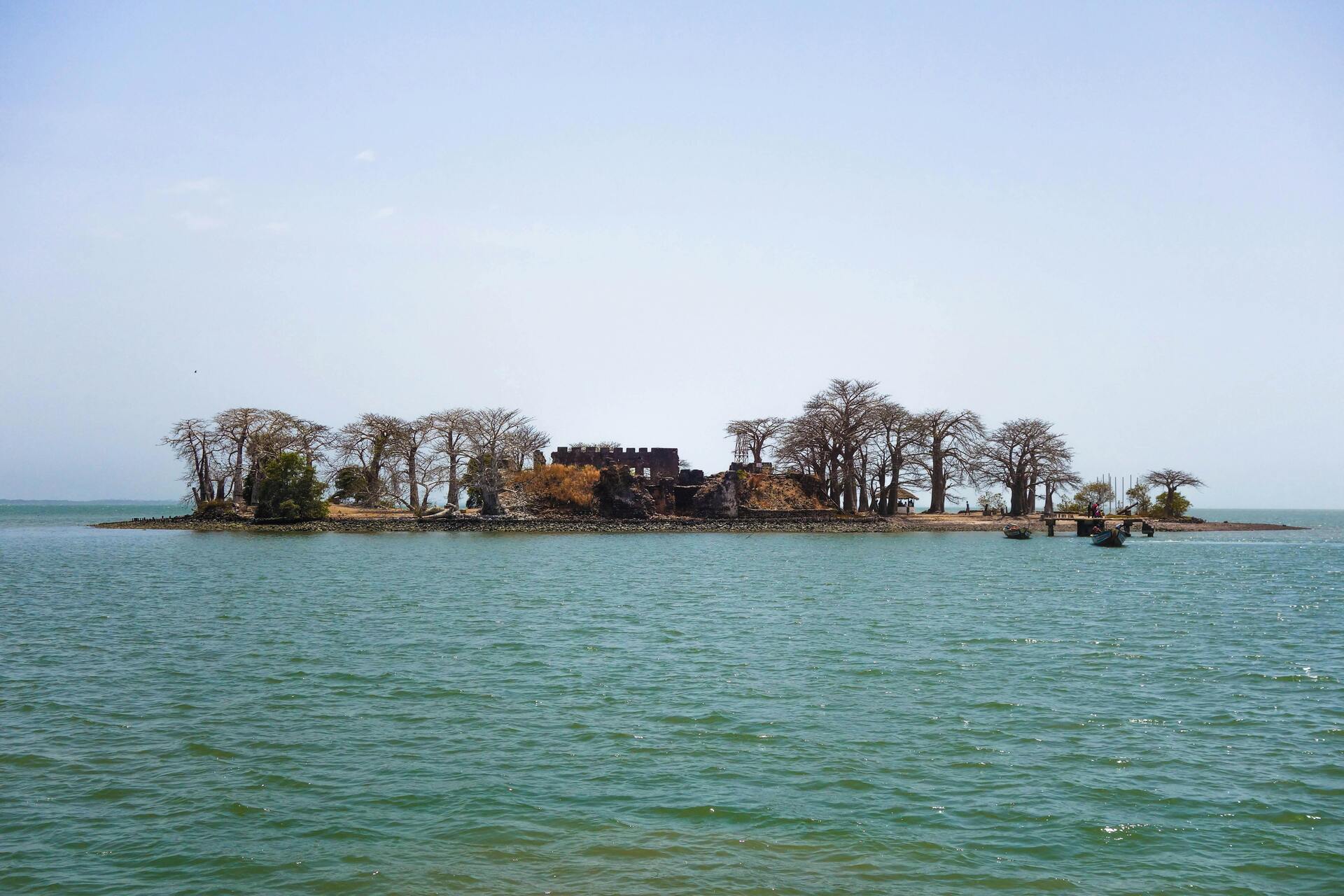
It is a small, low island in the brown water of the Gambia River, with a ruined fort, a few cannons, two baobab trees and a great deal of silence. It is also one of the most important slave-trade sites in West Africa, and it is slowly disappearing.
Kunta Kinteh Island lies about 30 kilometres upriver from the river mouth, opposite the villages of Albreda and Juffureh on the north bank. Until 2011 it was called James Island, and the fort on it Fort James. Since 2003 it has been a UNESCO World Heritage Site, together with the related sites around it. This is what you will see there, what happened there, and how to visit honestly.
Search our Network. Start here.
At a glance
- Where: in the Gambia River, about 30 km from the mouth, less than 3.2 km from Albreda on the north bank, North Bank Region
- Names: St Andrew's Island (Courland), James Island (English, from 1661), Kunta Kinteh Island (since 2011)
- UNESCO: inscribed in 2003 as "James Island and Related Sites", now "Kunta Kinteh Island and Related Sites"
- Related sites: Albreda, Juffureh, San Domingo, Fort Bullen and the Six-Gun Battery
- Getting there: by boat, usually as part of a day trip from the coast or Banjul
- Capital nearby: Banjul, across the river mouth
A German duke in the Gambia River
Few visitors expect this. The first Europeans to build a fort on the island did not come from England, Portugal or France, but from the Duchy of Courland, a small Baltic state in what is today Latvia. It was ruled by the Baltic German duke Jacob Kettler.
The island had long been used by local fishermen, and its hereditary owners were the rulers of Niumi on the north bank. In 1651 Courland acquired it from them, called it St Andrew's Island, and began building a fort named after the duke: Fort Jacob. Courland was a tiny European power with big colonial dreams. It also held the Caribbean island of Tobago.
The dream did not last. The Dutch took the fort in 1659, and in 1661 the English seized it. They renamed it after James, Duke of York, the future King James II: James Island and Fort James. The Dutch formally gave up their claim in 1664.
Gold, ivory, then people
Under English chartered companies, first the Royal Adventurers in Africa and from 1684 the Royal African Company, Fort James became Britain's main trading post on the river. At first the trade was in gold, ivory and beeswax. Then it was increasingly in human beings.
People were brought down the river and overland from the Senegambian interior, held on and around the island, and loaded onto ships bound for the Caribbean and North America. The fort also controlled the river itself: its governor forced foreign ships entering the Gambia to pay duties.
The fort changed hands again and again. The French captured it in 1695, and fighting, pirates and fire damaged it repeatedly. In 1750 the Company of Merchants Trading to Africa took over its administration, the same company that ran Cape Coast Castle on the Gold Coast. Long before Ghana and The Gambia existed as countries, the people taken from both coasts passed through the same British company's ledgers. You can read that side of the story in Tracing the Slave Routes of Ghana and West Africa.
Timeline of Kunta Kinteh Island
| When | What happened |
|---|---|
| 15th century | Portuguese traders arrive on the river. The island is a fishermen's site under the rulers of Niumi. |
| 1651 | The Duchy of Courland acquires the island and begins Fort Jacob. |
| 1659 | The Dutch take the fort. |
| 1661 | The English seize it and rename it James Island and Fort James. |
| 1684 | The Royal African Company takes over the Gambia trade. |
| 1695 | The French capture Fort James; it later returns to English control. |
| 1750 | The Company of Merchants Trading to Africa takes over its administration. |
| 2003 | UNESCO inscribes "James Island and Related Sites" as World Heritage. |
| 2011 | The island is renamed Kunta Kinteh Island during the International Roots Festival. |
| 2024 | The government's risk assessment confirms severe erosion and flooding. |
Why it is called Kunta Kinteh Island
In 2011 the island was renamed after Kunta Kinte, the young Mandinka man from Juffureh at the centre of Alex Haley's 1976 book Roots and the television series that followed. For millions of African Americans, Roots made Juffureh and this island a symbol of the ancestry the slave trade tried to erase.
The name is powerful, and it brings visitors. But be aware that historians have long questioned parts of Haley's genealogy. The island's significance does not depend on one man's story. It stands for the tens of thousands of real people, most of them unnamed, who passed through this river. We look at what is history and what is legend in Kunta Kinte: the man, the book and the legend.
An island that is disappearing
Erosion is eating the island. By some estimates it is now only about a sixth of the size it was when the fort was in use. In 2017 international reports described ruins collapsing into the river. In 2020 members of the National Assembly warned that the river could eventually take the whole site. In 2023 the tourism minister told parliament that more than US$40 million of a US$68 million World Bank-supported project could go towards restoring the island.
In August 2024 the Ministry of Tourism and Culture's Tourism Diversification and Resilience Project completed a risk assessment. Its finding was severe erosion from local wave action, made worse by increased flooding. Protective designs are being prepared. Until they are built, every year the island loses a little more ground. If you want to see it, go soon, and go with respect.
What you will actually see
- the ruined walls of Fort James, partly collapsed, with old cannons lying among them
- remains of storerooms and a small cell where, guides will tell you, captives were held as punishment
- a pair of large baobab trees, and the river all around
- on the mainland at Albreda, a small museum on the slave trade, the remains of the old French trading post and the "freedom flagpole"
- at Juffureh, the compound associated with the Kinte family
It is not a grand castle like Cape Coast Castle or Elmina Castle in Ghana. It is smaller, rawer and much more exposed. For many visitors that makes it more moving, not less.
How to visit
From the coast or Banjul
Most visitors come on a full-day "Roots" excursion from the coastal resorts. A typical route is:
- the ferry from Banjul to Barra across the river mouth, or a river boat all the way upriver
- Fort Bullen at Barra, built by the British in the early 19th century to stop slave ships after Britain abolished its slave trade
- by road to Albreda and Juffureh
- by boat to the island itself
The day is long, hot and depends on ferry times. A boat trip from the coast is more comfortable but takes longer on the water. See getting around The Gambia.
Practical tips
- Take water, a hat and sun cream. There is little shade on the island.
- Wear shoes you can step out of a boat in, because landings can be wet.
- Ask before photographing people in Juffureh and Albreda.
- Agree on what is included before you set off: boat, entrance fees, lunch. Then tip the guide and boat crew at the end. Our tipping guide explains how much.
- Visit in the dry season if you can, roughly November to May. See the best time to visit.
Visit Kunta Kinteh Island with a guide. These tours in The Gambia, many including Juffureh, Albreda and the island, are run by local operators. Entrance fees are already included in the tour price. Tips for your guide, driver and boat crew are not included, but they are always welcome.
One river, two coasts
If you have stood in the dungeons of Cape Coast or Elmina, this island completes the picture. The same companies, the same ships and often the same captains worked the Gambia River and the Gold Coast. The Gambia was even governed together with the Gold Coast and Sierra Leone for long periods. Governor Charles MacCarthy, who gave his name to MacCarthy Island upriver, died fighting the Asante at Nsamankow in 1824. Read the connection in The Gambia and the Atlantic slave trade and Gambia vs Ghana: two Atlantic nations connected by history.
More from The Gambia
- Juffureh and Albreda: the "Roots" village and the old trading post
- Kunta Kinte: the man, the book and the legend
- The Gambia and the Atlantic slave trade
- Wassu Stone Circles
- Janjanbureh and MacCarthy Island
- Banjul, the capital
- The Gambia tourist information: visa, entry and essentials
- Tipping in The Gambia
The Gold Coast side of the story
- Tracing the slave routes of Ghana and West Africa
- The last shipment
- The transatlantic slave trade: European greed, African power and the truth Ghana's castles still whisper
- Who sold whom? Ghana's slave history without the marketing
- Elmina Castle
Across the network
Sources: UNESCO World Heritage evaluation, "James Island and Related Sites" (No. 761 rev). World Monuments Fund: James Island. Erosion and restoration: The Point, March 2020, The Point, June 2023 and Gambiaj.com on the 2024 risk assessment. Courland and English periods: J. M. Gray, A History of the Gambia (1940).
Gambia Vibes · Part of the Ghana-Net network · Updated and fact-checked: 6 November 2026