Getting Around The Gambia
Gambia Vibes · Travel Tips · Transport
The Gambia is a long, narrow country wrapped around one river. That makes it small on the map and slow on the ground. From the coast to Basse at the eastern end is a full day. Crossing the river at its mouth means a ferry that may or may not be running well that week. Here is how to get around, and what each option is really like.
Search our Network. Start here.
The short answer
- On the coast: green tourist taxis (fixed, higher prices) or yellow-and-green town taxis (shared, cheap)
- Cheapest: gelli-gellis, the shared minibuses that leave when full
- Upriver: GTSC state buses from Kanifing, or a private driver
- Across the river mouth: the Banjul–Barra ferry, around half an hour on the water
- Across the river inland: the Senegambia Bridge near Farafenni, open since 2019
- Best way to see the river: by boat
Taxis on the coast
Green tourist taxis
Outside every big hotel you will find the green "tourist taxis". They are licensed for tourists, and drivers are often well informed and helpful. Prices are fixed, often on a board at the rank, and higher than in town taxis. For a first day, an evening out or a trip with luggage, they are the easiest choice. Agree the price before you get in, and agree whether it is one way or return with waiting time.
Yellow-and-green town taxis
The yellow cars with a green stripe are the everyday taxis. They pick up several passengers along fixed routes and charge each one a small fare. Flag one down, say where you are going, and if it fits his route you are in. You can also hire the whole car as a "town trip", but then agree the price first. A visitor who gets into an empty car will often be treated as a town trip, so be clear.
Gelli-gellis and garages
The gelli-gelli, a minibus also called a "Sprinter", is how most Gambians travel. Gelli-gellis have no timetable. They leave the "garage", the bus station, when every seat is full, and sometimes when more than every seat is full. They are cheap, slow, crowded and a real experience. They are also often overloaded, and safety standards are low. The main garages for upriver are Brikama and Bundung. Go early in the morning.
GTSC buses upriver
The state-owned Gambia Transport Service Company (GTSC) runs buses from its Kanifing station in Greater Banjul to Basse Santa Su, stopping at towns along the south bank. The Super Express service is air-conditioned and stops only at the main towns. Departures are in the morning, and the trip to Janjanbureh takes around five to six hours on a good day. GTSC has added new buses in recent years, including on the North Bank road. Check departure times locally the day before.
A private driver
For a trip upriver to Wassu, Janjanbureh or the River Gambia National Park, many visitors hire a car with a driver. It is the most comfortable and flexible option, and on bad roads a good driver is worth every dalasi. A full trip to Basse and back costs a lot more than the bus, often well over a hundred pounds each way. Shared between three or four people, it is reasonable. Agree in writing on price, fuel, the driver's food and overnight costs, and what happens if the car breaks down.
The Banjul–Barra ferry
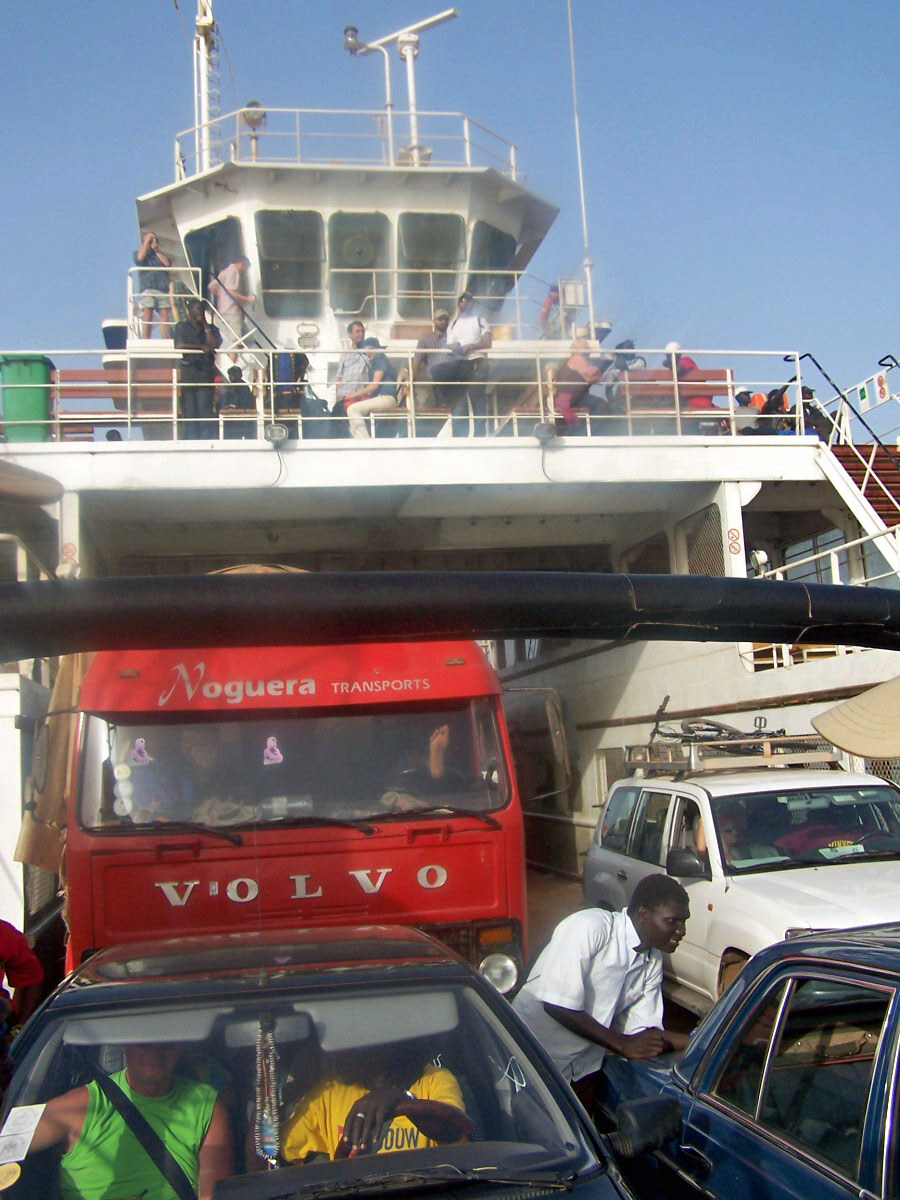
To reach the north bank from the coast, for Juffureh and Albreda, Kunta Kinteh Island or the road to Dakar, most people take the ferry from Banjul to Barra across the river mouth. The crossing takes around half an hour.
The ferries are run by the Gambia Ports Authority. For years the service suffered from old, broken-down boats, long queues and overcrowding. In March 2026 a new US$12 million hybrid ferry, the Barra, built by Damen and funded by an African Development Bank grant, entered service. It carries up to 2,000 passengers and has CCTV. Private operators have also been licensed on the route.
Ferry tips
- The UK government still warns that the Banjul–Barra ferries can be overcrowded and overloaded, and short of life-saving equipment.
- Avoid the busiest early-morning and evening crossings, and the days around Tobaski and other holidays.
- Stand near an exit on the open deck, not inside among the vehicles.
- Keep your bag in front of you; pickpockets work the ferries.
- Small "pirogue" boats also cross. They are faster but carry real risk. Don't use them in rough water.
The Senegambia Bridge
Since January 2019 the Senegambia Bridge has crossed the river between Farafenni and Soma, inland in the middle of the country. It ended the long ferry queues for trucks on the Trans-Gambia road between northern Senegal and the Casamance. For visitors heading upriver from the north bank, or driving between Dakar and the east of The Gambia, it is the reliable crossing, and the UK government recommends it over the Banjul–Barra ferry.
On the river
The Gambia River is the country, and the best way to understand it is from the water. Boat trips run from Denton Bridge and the creeks near Banjul, from Tendaba and from Janjanbureh. The classic outings are a "Roots" trip to Kunta Kinteh Island, birdwatching in the mangroves, and boat trips around the chimpanzee islands of the River Gambia National Park. Pirogues with an outboard engine are the most common. Ask for life jackets and check that they are on board before you leave the bank.
Getting around at a glance
| Option | Best for | Watch out for |
|---|---|---|
| Green tourist taxi | first days, evenings, luggage | higher fixed prices; agree first |
| Town taxi | short trips on the coast | "town trip" pricing if you ride alone |
| Gelli-gelli | cheap travel, local experience | overloading, waiting, safety |
| GTSC bus | upriver on a budget | morning departures only |
| Private driver | comfort, flexibility, groups | agree all costs in writing |
| Banjul–Barra ferry | north bank, Juffureh, Dakar | crowds, delays, pickpockets |
| River boat | birds, chimps, Kunta Kinteh | life jackets, sun, no shade |
Roads and driving
Main roads around Greater Banjul are paved but narrow, potholed and poorly lit, and most roads upriver are not paved. In the rainy season, June to October, you need a four-wheel drive away from the main roads. Police checkpoints are frequent: stop, be polite, have ID ready. If you drive yourself, carry an International Driving Permit. And whatever you use, do not travel on rural roads after dark. More in Gambia travel advice.
Arriving at the airport
Banjul International Airport is at Yundum, about half an hour from the coastal resorts. Package holidays include a transfer. If you are travelling independently, take a green tourist taxi from the rank, or arrange a pickup in advance. Have your US$20 airport security fee ready in cash: see tourist tax and airport fees.
Let someone else drive. Day trips and river tours with transport included take the ferry queues, the bargaining and the potholes off your hands. These tours are run by local operators in The Gambia. Entrance fees are already included in the tour price. Tips for your guide, driver and boat crew are not included, but they are always welcome.
More Gambia travel tips
- Best time to visit The Gambia
- Gambia travel advice: safety, bumsters and honest tips
- Money in The Gambia
- Tipping in The Gambia
- Tourist tax and airport fees
- The Gambia tourist information
Where to go
- Banjul, the capital
- Wassu Stone Circles
- Janjanbureh and MacCarthy Island
- The Gambian coast: Bakau to Kartong
Across the network
Sources: AllAfrica on the new Barra ferry, March 2026. The Point on the new ferries and private operators. The Point on GTSC buses, January 2026. Fairplay Gambia, public transport. UK FCDO, safety and security. Government of Canada travel advice.
Gambia Vibes · Part of the Ghana-Net network · Updated and fact-checked: 6 November 2026