Gambian Soldiers in Britain’s Wars Against the Asante
Gambia Vibes · Heritage · Military history
In a neglected cemetery behind Cape Coast Castle in Ghana stands a plain stone block, put up by the officers and men of a regiment that shipped soldiers from Cape Coast to the Gambia River. Nearby rises a weathered obelisk to a governor whose name is still on an island in the Gambia. The graves tell a story that links two countries more than 1,500 kilometres apart. Did men from the Gambia fight for Britain against the Asante? The honest answer is more interesting than a simple yes.
Search our Network. Start here.
At a glance
- The setting: for long periods The Gambia, Sierra Leone and the Gold Coast were governed as one British West Africa, with shared governors and shared troops
- The Asante wars: 1824, 1863–64, 1873–74, 1895–96 and 1900–01
- The garrison: Bathurst (Banjul) and Cape Coast were held by the same units: the Royal African Colonial Corps, then the West India Regiments
- The graves: the 2nd West India Regiment's memorial of 1891–92 and the MacCarthy monument of 1826, both at Cape Coast
- The Gambia Company: founded on 30 November 1901, after the last Asante war
- Later service: Kamerun in the First World War; the 81st (West Africa) Division in the Second
One army for one coast
To understand the question, forget today's borders. In the early 19th century, Britain's West African possessions were tiny: Bathurst on the Gambia, Freetown in Sierra Leone, and the castles and forts of the Gold Coast. From 1821 they were run from Freetown by one governor, Sir Charles MacCarthy. The soldiers who held these places belonged to the same few units and moved between them by ship.
The main unit in the 1820s was the Royal African Colonial Corps, with detachments in the Gambia, Sierra Leone and on the Gold Coast. Many of its men were Africans recruited in the region, among them liberated Africans freed from slave ships, alongside European officers and soldiers.
1824: MacCarthy and the Asante
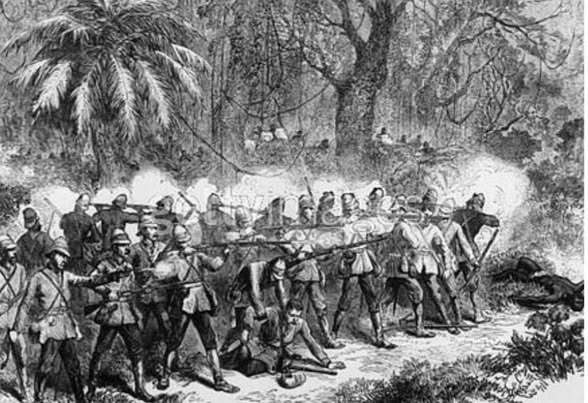
In January 1824 MacCarthy led a small force against the advancing Asante: about 80 men of the Royal African Colonial Corps, 170 of the Cape Coast Militia and 240 Fante fighters under their own chiefs. At Nsamankow, on 21 January, his force ran out of ammunition and was overwhelmed. MacCarthy was killed, and the Asante kept his head as a trophy. A few months earlier, the island in the Gambia River where Georgetown was being founded had been named in his honour: MacCarthy Island. In 1826 his colleagues raised a sandstone obelisk to him at Cape Coast. It still stands, almost unreadable now: the MacCarthy monument.
Were any of the Royal African Colonial Corps men at Nsamankow from the Gambia? Possibly. The corps served both places. But no record we have found names a Gambian soldier in that battle.
The later wars
From the 1820s the West India Regiments, Black regiments of the British Army, took over much of the garrison duty in West Africa, at Bathurst as well as at Cape Coast. They fought in several Asante wars. Detachments served with MacCarthy in 1824. In 1873–74 they were mostly used as carriers and on supply lines during Wolseley's march on Kumasi, when about 2,000 soldiers came from the West India Regiments and the Sierra Leone and Nigeria forces. Their role in 1895–96 and 1900 was small. Their men were recruited mainly in the Caribbean.
The graves at Cape Coast
The clearest physical link between the two coasts is in the old war cemetery at Cape Coast. There stands a plain block inscribed "ERECTED BY THE OFFICERS AND MEN OF THE 2ND WEST INDIA REGIMENT 1891 – 1892". The regiment was stationed at Cape Coast Castle for about eighteen months, from late 1890 to mid-1892. In July 1891 detachments were shipped north from Cape Coast to the Gambia for the Kombo expedition against Fodi Kabba and his allies. Roughly twenty of its men died of disease during the posting and lie in the plot, unnamed. The stone carries no personal names, only the regiment's.
So the same soldiers, from the same barracks, marched against the Asante on one coast and against the marabout forces of the Kombo on the other. They were Caribbean-born, not Gambian. But they are the human thread between Cape Coast and the Gambia River. Read the full story on our sister site: the regiment's stone, from Cape Coast to the Gambia: the 2nd West India Regiment and silent stones of empire.
What the record does not show
You will sometimes read that "Gambian soldiers fought against the Asante". It is possible that individual Gambians served in units that did. But a distinct Gambian unit did not exist until the Gambia Company was formed on 30 November 1901, after the last Asante war of 1900–01. Even then, its first 75 recruits were Mende men from Sierra Leone. By February 1902 the company had its full strength of 120, of whom only about a quarter were Gambian. If you have family records, letters or medals that show otherwise, we would very much like to hear from you.
Timeline
| When | What happened |
|---|---|
| 1816 | Bathurst founded; garrisoned by British and African troops. |
| 1821 | Gold Coast placed under the Sierra Leone government; MacCarthy governs all British West Africa. |
| 21 Jan 1824 | MacCarthy killed by the Asante at Nsamankow. |
| 1826 | The MacCarthy monument is raised at Cape Coast. |
| 1831–32 | Barra War: West India Regiment, Royal African Corps and Sierra Leone Militia fight the Mandinka of Niumi. |
| 1873–74 | Wolseley's Asante campaign; West India Regiments as carriers and support. |
| 1890–92 | 2nd West India Regiment at Cape Coast; detachments sent to the Gambia in July 1891. |
| 1900–01 | War of the Golden Stool, the last Asante war. |
| 30 Nov 1901 | The Gambia Company of the West African Frontier Force is founded. |
| 1914–16 | The Gambia Company serves in the Kamerun campaign. |
| 1940s | The Gambia Regiment serves with the 81st (West Africa) Division. |
| 1958 | The Gambia Regiment is disbanded. |
What Gambian soldiers did do
The story of Gambian soldiers in British service is real. It is simply later. The Gambia Company fought in the First World War campaign against the Germans in Kamerun. In the Second World War it was expanded into the Gambia Regiment, which joined the 6th (West Africa) Brigade of the 81st (West Africa) Division. Some of the men who died are buried at the Fajara War Cemetery on the coast. See The Gambian coast. Ghana's soldiers shared the same history, in the Gold Coast Regiment of the same West African Frontier Force.
See Banjul's history with a guide. City tours of Banjul and the coast are run by local operators in The Gambia. Entrance fees are already included in the tour price. Tips for your guide and driver are not included, but they are always welcome.
More Gambian heritage
- Charles MacCarthy
- The Gambia and the Gold Coast: one British West Africa
- The Gambia and the Atlantic slave trade
- Janjanbureh and MacCarthy Island
- Banjul, the capital
The Cape Coast war cemetery
- The 1824 War Cemetery, Cape Coast
- The regiment's stone
- The MacCarthy monument
- Cape Coast Castle Museum
Across the network
Sources: Cape Coast 1824 War Cemetery: the 2nd West India Regiment stone. Charles MacCarthy: forces at Nsamankow. Gambia Regiment: founding of the Gambia Company, 1901. Military history of The Gambia. West India Committee: the West India Regiments in the Asante wars. The Kombo wars.
Gambia Vibes · Part of the Ghana-Net network · Updated and fact-checked: 6 November 2026